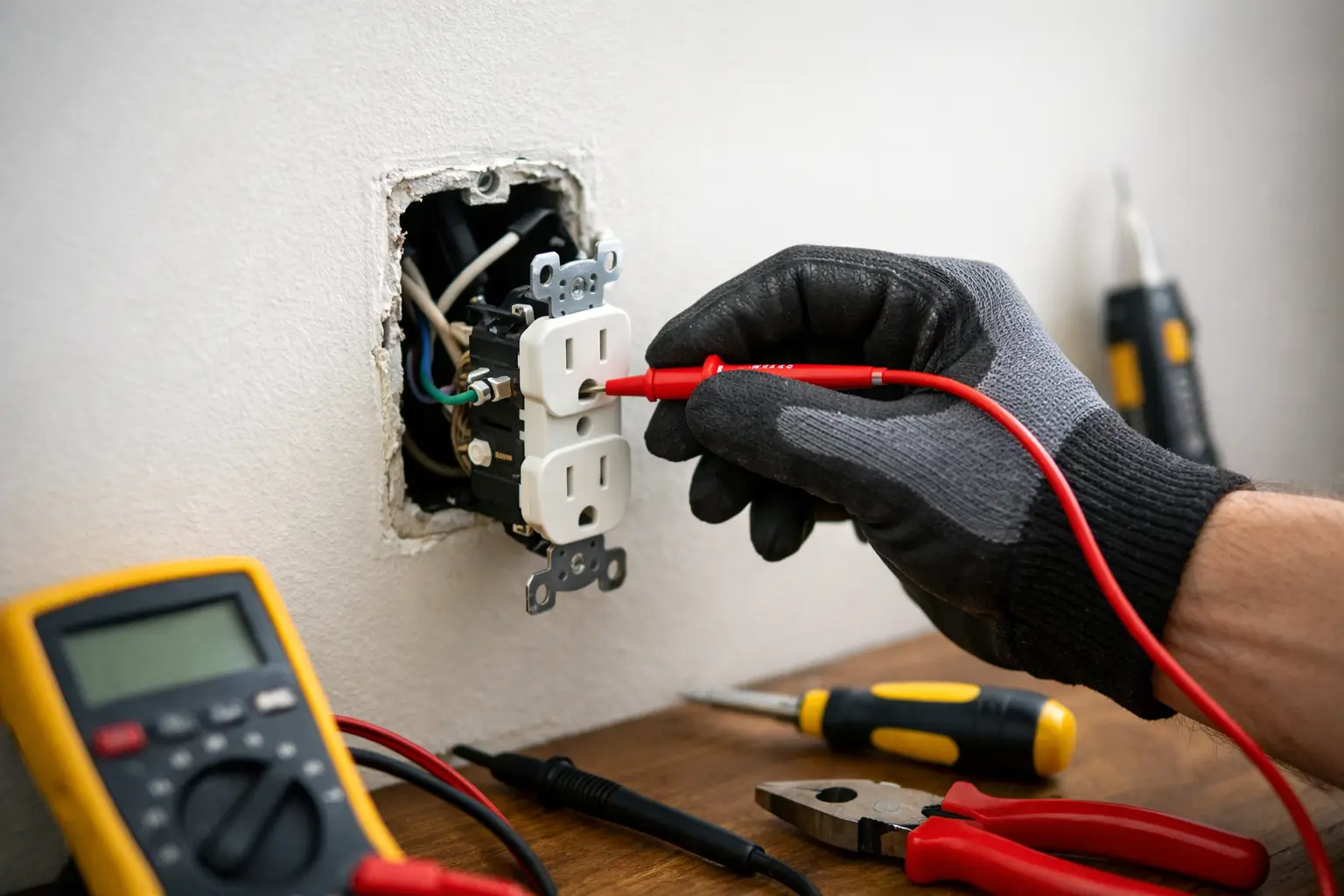

A dead outlet usually shows up at the worst time – your phone will not charge, the coffee maker stops mid-morning, or a tenant tells you half the room has no power. If you are wondering how to fix dead electrical outlets, the right answer starts with safety and a clear diagnosis, not guesswork.
Some outlet problems are simple. A tripped breaker or a resettable GFCI outlet can shut off power without any visible warning. Other cases point to loose wiring, a failed receptacle, or a larger circuit issue that needs professional electrical troubleshooting. Knowing the difference can save time, prevent damage, and keep your property safe.
What causes outlets to stop working?
A dead outlet is a symptom, not a diagnosis. In homes and commercial spaces, the most common cause is a tripped circuit breaker. That can happen after plugging in too many devices, running a high-load appliance, or having a short on the circuit.
Another frequent cause is a tripped GFCI outlet. These outlets are often installed in kitchens, bathrooms, garages, laundry rooms, outdoor areas, and sometimes even in upstream locations that protect other standard outlets farther down the line. That means the dead outlet in your office, patio, or break room may not have the reset button on it at all.
The outlet itself can also fail. Receptacles wear out over time, especially in high-use areas where plugs are inserted and removed constantly. Loose backstabbed wires, damaged terminals, heat buildup, or age can leave an outlet dead even when the breaker appears normal.
Then there are the more serious possibilities: a loose connection inside the wall, a broken neutral, damaged wiring, or a panel issue. Those are not DIY-friendly problems. They require testing, experience, and a licensed electrician who can trace the fault correctly.
How to fix dead electrical outlets step by step
Before you touch anything, unplug devices from the dead outlet. Then test the device in another working outlet so you know the appliance is not the problem.
Check the breaker panel first
Go to your electrical panel and look for a breaker that is tripped. It may not always look fully off. Often it sits in the middle position. Reset it by switching it firmly to OFF first, then back to ON.
If the breaker trips again right away, stop there. That usually means there is an active fault on the circuit. Repeatedly resetting a breaker is not a fix. It is a sign that the circuit needs proper diagnosis.
Look for a tripped GFCI outlet
Next, inspect nearby GFCI outlets. Press the RESET button on any outlet that has one, especially in bathrooms, kitchens, garages, exterior walls, utility rooms, and adjacent spaces. In many properties, one GFCI protects multiple downstream outlets.
If the GFCI will not reset, or it clicks and trips immediately, there may be moisture, a wiring fault, or a downstream problem. That is a good point to bring in a pro rather than keep forcing it.
Test for power at neighboring outlets
Check nearby outlets and lights on the same wall or in the same room. If several are out, the issue is more likely tied to the circuit than to one failed receptacle. If only one outlet is dead, the problem may be local to that device or to a loose connection at that box.
This distinction matters. A single failed outlet can sometimes be replaced. A section of dead outlets can point to a hidden wiring problem upstream.
When the outlet itself is the problem
A worn or damaged receptacle can fail without tripping the breaker. Signs include scorch marks, discoloration, a loose plug fit, buzzing, a burning smell, or intermittent power. If you notice any of those, turn off the breaker immediately and do not use the outlet.
For experienced DIYers, replacing a standard outlet may sound straightforward. But there is a trade-off. If the original wiring was done poorly, if the box is crowded, if aluminum wiring is present, or if the outlet is part of a switched or split circuit, a simple swap can turn into a safety issue fast.
That is why many property owners choose to have outlet replacement handled professionally. It is quicker, cleaner, and it confirms whether the outlet was truly the failure point or just where the symptom appeared.
Signs the problem is bigger than one outlet
Sometimes a dead outlet is the first clue that something else is going on. If the breaker never tripped and the GFCI is not the issue, hidden loose connections become more likely. These can happen at another outlet, a switch box, a junction, or even at the panel.
Watch for warning signs such as flickering lights, multiple dead outlets, outlets that work only sometimes, warmth at the wall plate, crackling sounds, or recent remodeling work. In older homes, aging wiring and previous handyman repairs can also play a role.
Commercial spaces have their own complications. Tenant improvements, added equipment, shared circuits, and code upgrades can create situations where what looks like a small outlet problem is actually a load or wiring layout issue. In those cases, accurate troubleshooting matters more than speed alone.
What not to do when troubleshooting a dead outlet
People often lose time by assuming the nearest problem is the actual cause. They replace the outlet, reset breakers over and over, or open boxes without verifying which circuit they are on. That can be frustrating at best and dangerous at worst.
Do not ignore heat, odor, or visible damage. Do not install a new receptacle on a circuit with an unresolved fault. Do not rely on a noncontact tester alone if you are opening boxes. And do not work on live wiring.
Electrical issues are one area where confidence should come after diagnosis, not before it. A clean repair starts with knowing exactly why power was lost.
How to fix dead electrical outlets safely in older homes
Older homes often need a more careful approach. Wiring methods changed over the years, and not every older circuit was designed for today’s electrical demands. You may find ungrounded outlets, overused circuits, brittle insulation, or prior repairs that do not meet current code.
In these properties, a dead outlet can be a maintenance issue, but it can also be a sign the system is due for upgrades. If you are planning a remodel, adding appliances, or dealing with recurring outlet failures, it may make sense to look beyond the single repair and evaluate the circuit as a whole.
That is especially true in Las Vegas homes where additions, garage conversions, outdoor lighting, and newer smart devices have increased electrical loads over time. A targeted repair may solve the immediate issue, but a broader correction can prevent repeat service calls.
When to call a licensed electrician
If the breaker trips repeatedly, the outlet smells burnt, multiple outlets are out, or you cannot identify the source of the failure, it is time to call a licensed electrician. The same goes for any issue involving commercial spaces, older wiring, aluminum conductors, or signs of overheating.
A professional can test the circuit, isolate the fault, inspect the condition of the wiring, and make the repair to code. That matters for safety, but it also matters for long-term reliability. No one wants the same outlet failing again a month later because the real problem was hidden upstream.
For homeowners, property managers, and business owners, expert troubleshooting usually saves money compared with repeated trial-and-error fixes. It also gives you a clear answer on whether the repair is minor or part of a larger electrical concern.
At RS Electric LLC, this is exactly the kind of work we handle every day – fast diagnostics, honest recommendations, and dependable repairs for residential and commercial properties.
A smart fix starts with the right diagnosis
If you are searching for how to fix dead electrical outlets, the safest path is to start simple, rule out the common causes, and know when the issue has moved beyond a quick reset. Some outlet failures are minor. Others are warning signs worth taking seriously.
Power should be reliable, safe, and ready when you need it. When an outlet goes dead, treating the cause instead of the symptom is what gets you there.
Need a licensed electrician in Las Vegas?
RS Electric LLC handles electrical troubleshooting and repair for homes and businesses across Las Vegas, Henderson, North Las Vegas and Summerlin. Licensed, bonded & insured (NV C-2 #0078370), certified MBE, 4.9★ on Google. Se habla español.